


Why Are North Coast Property Prices So High? The Real Story


School's back, summer's definitely over — but one beach conversation lingers: why are Real Estate prices so high, particularly in the North Coast?
The 230 km stretch from Marina/Alamein to Marsa Matrouh, nicknamed "El Sahel El Sherir," the wicked coast, because of its high prices, is now among Egypt's priciest real estate markets. It captured a third of Egypt's top ten developers' sales, with $10.4 Billion in 2025 — nearly 6 times the $1.8 billion recorded just five years ago.
Inflation alone doesn't explain that jump: Egypt's general price index rose by only 2.16 times over the same five years — a fraction of the near-20-fold rise in North Coast sales value labelled in EGP. Most of that growth reflects real drivers — new supply coming online, a shift toward higher-priced mega-developments, and genuine demand growth — rather than currency debasement.
This summer, mega-developments like Ras El Hekma and Alam El Roum have driven property values to unprecedented heights, with many claiming Sahel has outpriced even Europe's coastal hotspots.
Are North Coast prices genuinely irrational?
Addressing that requires answering three core questions:
Local comparison: Does the North Coast outprice other premium Egyptian real estate areas?
Global comparison: Does it actually cost more than established European coastal hotspots?
Market reality: Is the hefty price tag fundamentally justified, or is the market simply overheated by speculation?
The Sahel Price Everyone Quotes Is the Wrong One
Ras El Hekma's priciest first-line villas list at $8-$9 million (EGP 400–450 million) — but that's the developer's headline price: an installment-plan figure quoted years before delivery, with developers often offering 40–50% rebates for full cash payment at signing. With CBE rates at 19%, financing costs alone explain much of that gap.
Developer headline prices are artificial, driven by financing costs rather than real market value, and shouldn't serve as a pricing benchmark. Egypt needs price transparency regulation and real bank mortgage financing, as in mature markets, so buyers can compare and decide with full information.
To keep the two apart throughout this piece: "headline price" means a developer's installment-plan price for a new, undelivered unit; "asking price" means what an individual owner lists a resale, fully paid unit for. From this point onward, the analysis uses only asking prices for resale, fully paid units, sourced from portals such as Aqarmap, Property Finder, Dubizzle and BlueSky, as the reference for average property prices across different areas of Egypt. The same methodology was applied when researching European average property prices.
So, What's the Real Price Tag on El Sahel El Sherir?
In prime seafront locations, asking prices for chalets currently span a massive spectrum: starting around $1,000 (EGP 50,000) per square meter in classic resorts like Marina, and soaring up to $4,000 (EGP 200,000) per square meter in ultra-luxury developments like Emaar's Marassi. However, these are strictly asking rates — actual closing prices frequently settle much lower, a trend that becomes especially pronounced as the market cools entering the winter off-season.
Two market practices are worth flagging upfront, since they run through every comparison in this piece. First, resellers commonly grant execution rebates of 10–20% off asking prices for buyers who pay cash to close the transaction— a discount rarely advertised but routinely negotiated. Second, Egyptian listings quote gross area, including a proportional share of stairwells, corridors and lifts, while European listings — under stricter measurement regulation — quote private or usable area only, which is meaningfully smaller for a comparable apartment. In practice these two effects pull in opposite directions and roughly offset each other: the rebate lowers the effective Egyptian price, while the gross-area convention inflates the sqm base it's divided by. Keep both in mind when reading the Egypt-versus-Europe figures later on.
First Question: Is Sahel Pricier Than Other Parts of Egypt?
The short answer: Sahel outprices Cairo's top neighborhoods but still trails the Red Sea.
Cairo
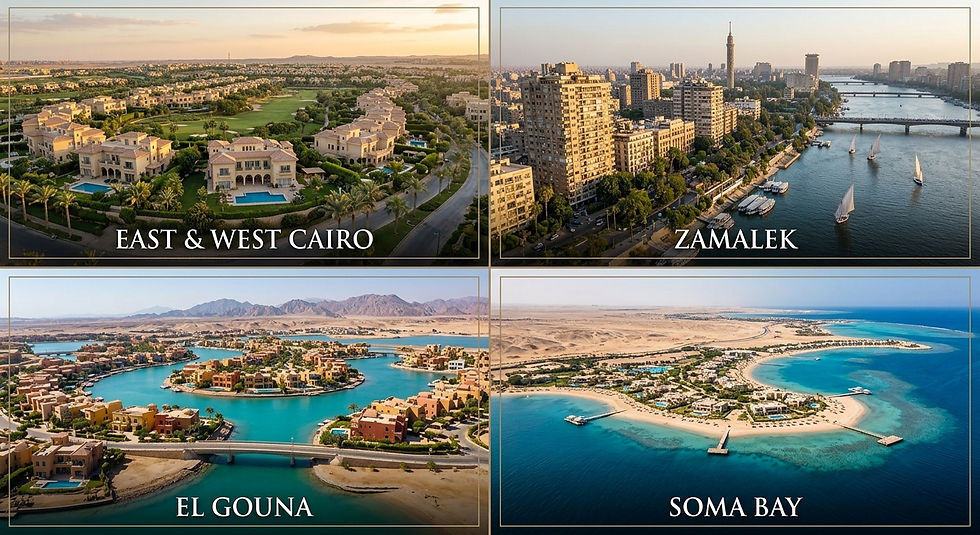
Asking prices in West Cairo's premium compounds start around $1,200/sqm (EGP 60,000) in places like O West and Mountain View, climb to $1,800/sqm (EGP 90,000) in New Giza and $2,200/sqm (EGP 120,000) in Palm Parks, and average $2,400/sqm (EGP 140,000) in Allegria — with select listings there peaking at $3,600/sqm (EGP 181,000).
Of course, buyers can easily find cheaper prices in less hyped or older compounds — decent options can be found around $800/sqm (EGP 40,000), still below Sahel's entry point of $1,000/sqm (EGP 50,000).
Prices in East Cairo run slightly higher than West Cairo, with hyped compounds like Eastown (Sodic) and Swan Lake both averaging $1,600/sqm (EGP 80,000), Mivida and Villette (Sodic) climbing to $2200/sqm (EGP 110,000), and Katameya Heights topping the list at $3,800/sqm (EGP 190,000).
Zamalek property prices are comparable to those of premium North Coast compounds, at around $1,000–$4,000/sqm, with Nile-view apartments at the southern end of the island fetching the highest prices. However, living in Zamalek offers an entirely different proposition: a dense urban landscape of high-rise buildings and heavy traffic, entirely lacking the gated compound amenities found in Sahel.
Despite its congestion, Zamalek remains an elite, highly selective market driven by two unique factors: extreme inventory scarcity on the island and strong demand from foreign residents drawn by the neighborhood's numerous embassies, international institutions and dense greenery.
Red Sea
El Gouna plays in a different league altogether: prices start at $2,200/sqm (EGP 110,000) and rocket up to $5,000 (EGP 250,000) for sea-view apartments overlooking the Marina. Soma Bay, by comparison, feels almost like a bargain — averaging $3,00/sqm (EGP 150,000) despite many units offering that same coveted sea view.
The data reveals a surprising market hierarchy, where seasonal exclusivity often defies traditional real estate logic:
North Coast vs. Cairo: Elite Sahel compounds now outprice premium developments in Cairo, despite the capital offering the distinct advantages of year-round living and much higher market liquidity.
Red Sea vs. North Coast: Both El Gouna and Soma Bay remain, on average, more expensive than the North Coast. While Soma Bay serves as a more accessible alternative to the ultra-premium El Gouna, both Red Sea destinations completely eclipse Sahel in everyday livability and year-round services.
The True European Rivals: Ultimately, it is El Gouna and Soma Bay — not the North Coast — that genuinely parallel the European coastal experience, for two reasons. First, like European coastal cities, both are livable year-round rather than for a single summer season. Second, both offer the same calm, low-density, unhurried pace of life that defines European resort towns — a contrast to the crowding and noise of Egypt's big cities. Their flawless weather, year-round swimmable seas, and integrated community infrastructure deliver a complete, cosmopolitan lifestyle rather than just a temporary summer retreat.
Second question: Is Sahel Genuinely More Expensive Than Europe's Coastal Cities?
Definitely not.

Across Europe, residential prices vary enormously — even for standard three-bedroom apartments. Italy, for example, price per sqm ranges from around $1,200 in Sicily to $13,200 in Costa Smeralda. Albania and Turkey remain among the most accessible markets, at roughly $1,200–$3,300, followed by Montenegro at $2,970–$4,400, Spain at $2,200–$8,250, and Croatia at $3,300–$7,500. France is significantly more expensive, ranging at $5,830–$10,230 across major coastal cities — and reaching $13,200–$27,500 for prime seafront properties in places such as Cap d'Antibes. Greece, perhaps the most relevant benchmark for Egyptian buyers, offers entry points around $2,200–$3,300/sqm in areas such as Thessaloniki and Crete, while Glyfada prices stand at approximately $4,400–$12,320/sqm and Mykonos reaching $7,700–$16,500/sqm.
Country / coastal market | Average apartment price (USD/m²) | Notes | Main source |
Albania — Golem, Durrës, Qerret, Vlorë, Sarandë, Radhimë/Orikum, Dhërmi | $1,600–$4,000/sqm | Broad coast average: about $2,037/sqm. The low end is mass-market Golem/Qerret; higher-value southern markets include Sarandë (~$2,247/sqm), Vlorë (~$2,604/sqm) and Dhërmi (~$3,628/sqm). These are active-listing asking prices. | |
Spain — Costa del Sol: Málaga, Estepona, Marbella, Mijas, Fuengirola, Benalmádena, Torremolinos | $2,830–$5,660/sqm | City averages span roughly $2,832/sqm in Torremolinos to $5,664/sqm in Marbella. Prime Marbella waterfront, Golden Mile and Puerto Banús assets sit above this city-wide benchmark. Figures are indicative asking-price estimates. | |
France — Nice, Côte d’Azur | ~$5,720/sqm median; ~$6,100/sqm average | This is a robust transaction-based benchmark: approximately 7,312 recorded apartment sales in 2025. Prime waterfront and luxury submarkets such as Cap d’Antibes, Cannes Croisette and Saint‑Tropez should be analysed separately and can be materially higher. | |
Italy, North Coast — Liguria: Sanremo, Rapallo, Santa Margherita Ligure, Portofino/Cinque Terre area | $4,130–$9,440/sqm | Representative range for prime Ligurian coastal markets. Portofino and the best Cinque Terre stock can exceed this range, but the market is thin and individual asset characteristics dominate valuation. | |
Italy, South Coast — Amalfi Coast: Positano, Amalfi, Sorrento | $4,130–$11,800/sqm | Typical pricing is highly location-specific: Positano is the most expensive mainstream market; Sorrento generally provides a lower entry point. UNESCO, topography, parking, view and beach access have a major effect on pricing. | |
Italy, South Coast — Sardinia: Olbia, Porto Rotondo, Costa Smeralda | $2,950–$11,210/sqm | General Sardinia is far cheaper than Costa Smeralda. Prime Costa Smeralda apartments generally sit around $6,490–$11,210/m², while upper-end waterfront or marina-adjacent property can exceed this band. | |
Italy, South Coast — Sicily: Palermo, Syracuse, Cefalù, Taormina | $1,200–$4,250/sqm | Sicily remains the lowest-priced major Italian coastal macro-market. The island-wide average is close to $1,380/m², while Taormina, Cefalù waterfront and selected east-coast tourist locations command a substantial premium. | |
Montenegro — Budva, Kotor, Tivat | $3,900–$5,180/sqm | Indicative mainstream coastal market: Budva around $3,905/sqm, Kotor around $4,372/sqm, and Tivat around $5,181/sqm. | |
Croatia — Split, Dubrovnik, Istria: Rovinj and Poreč | $3,570–$6,500/sqm | Split is around $4,750/sqm based on recent market data, while Dubrovnik and premium Istrian coastal towns can command higher levels. Old Town, first-line seafront, heritage restrictions and tourist-rental potential create large local differences. | |
Turkey — Alanya and Antalya coast | $1,265–$3,300/sqm | Alanya averages roughly $1,265/sqm in one current series, while better Antalya coastal submarkets generally trade higher. Bodrum, Yalıkavak and Türkbükü are not comparable to this mainstream range; luxury properties there can be several multiples higher. | |
Turkey — Bodrum Peninsula: Bodrum, Yalıkavak, Türkbükü | ~$3,000–$9,000+/sqm | This is a premium and highly fragmented market rather than a uniform coastal-city benchmark. Sea-view, gated, marina-adjacent and direct-waterfront assets are priced separately; true beachfront villas can exceed the top of the range by a wide margin. | |
Greece — Athens Riviera: Glyfada, Voula, Vouliagmeni, Varkiza | $4,720–$13,220/sqm | Greece’s leading mainland coastal corridor. Glyfada and Voula provide the more accessible part of the premium range; Vouliagmeni and new, sea-adjacent product command the highest prices. | |
Greece — Mykonos: Mykonos Town, Psarou, Platis Gialos | ~$9,000/sqm average; prime assets higher | Mykonos is a luxury island market with an asking-price average around $9,000/sqm. Beachfront, sea-view and hospitality-grade assets can trade materially above the average; seasonality and planning restrictions are decisive. | |
Greece — Santorini: Oia, Fira, Imerovigli | ~$5,140–$6,780/sqm | Oia is around $6,780/sqm, with Thira/Fira lower at roughly $5,150/sqm. This market is constrained by caldera views, heritage controls, accessibility and short-term-rental demand. | |
Greece — Crete: Chania, Heraklion, Rethymno | $2,360–$3,660/sqm | Island-wide asking prices are around $2,750/sqm; Chania leads at roughly $3,660/sqm, while Heraklion is closer to $2,360/sqm. The range is suitable for standard apartments, excluding resort-branded or exceptional waterfront stock. | |
Greece — Other islands: Paros, Naxos, Corfu, Lefkada | ~$2,750–$5,900/sqm | This is a broad indicative range: location, air connectivity, permitted density, season duration and proximity to beaches create significant dispersion. Prime Cycladic and Ionian stock can exceed the upper end. | |
Greece — Thessaloniki coast: Kalamaria, Peraia, Nea Michaniona | ~$2,360–$3,540/sqm | A comparatively affordable urban coastal market relative to Athens Riviera. It benefits from year-round city demand, not merely seasonal holiday use. | |
Greece — Kalamata and wider Messinia: Gialova, Pylos, Koroni, Methoni, Costa Navarino surroundings | $1,650–$3,400/sqm | Kalamata is a city market with lower entry prices than branded resort stock. Wider Messinia includes lower-priced rural and traditional-town housing, while Costa Navarino-adjacent and branded-resort assets trade at a significant premium. | |
Greece — Costa Navarino branded resort residences | From ~$8,850/sqm | This is not representative of the wider Messinia apartment market. It is a branded, integrated golf-and-hospitality resort submarket, and therefore should be benchmarked against luxury resort residences rather than Kalamata or Pylos housing. |
Many North Coast prices may look comparable to European coastal markets — but are we really comparing the same experience?
European coastal cities offer strong public services, healthcare, safety, education, culture and commercial infrastructure. But the typical property is often quite older and comes with limited on-site amenities, high urban density and multi-storey developments, with services rarely included beyond occasional pool access. And let's not forget the hidden cost: European properties often come with significantly higher maintenance fees and property taxes than Egypt.

By contrast, much of the Sahel proposition is built around gated communities, private amenities, security and a resort-style lifestyle. Hence, to establish a fair comparison with standard European properties, we should use standard urban residences in the North Coast, outside resort developments.
On that basis, the gap can be striking: Alamein city starts at around $400/sqm, roughly 66% below the entry price of Europe's most affordable coastal markets — though, as noted above, part of that gap is measurement convention (gross vs. usable area) rather than a pure price difference, and is partly offset by Egypt's typical execution rebates.
So, What Does the European Equivalent of an Egyptian Resort Actually Cost?
Let's compare like for like: gated, beachfront communities with private amenities.
Project | Scale / Concept | Resale price per sqm for 3-bed apts (delivered) |
Luštica Bay (Montenegro) | ~1,500 units, marina, golf, beaches, hotels. Developed by our own Orascom Development | |
Costa Navarino (Greece) | Integrated resort, golf, hotels, branded residences. Comes with a mandatory 18-year rental agreement promising a 3.5% yield before tax, and either 4 weeks' usage per year (incl. 2 summer weeks) or 8 weeks (excl. summer) | |
Marbella Golden Mile (Spain) | Ultra-prime beachfront strip with resort-style compounds (maintenance fees €260/month) | |
The Westin Salgados Residences (Algarve, Portugal) | Branded homes inside beach & golf resort | |
Vlora / Orikum seafront (Albania) | Emerging Mediterranean marina strip, developed by multiple players — accessible and increasingly attractive, but closer to entry-level North Coast resorts in density, infrastructure and finish |
For luxury resorts such as Marassi and Almaza Bay, the closest European equivalents are Luštica Bay in Montenegro and Costa Navarino in Greece. Both offer integrated, developer-led resorts with extensive amenities — but their average prices far exceed even the most expensive Egyptian properties. Costa Navarino's purchase conditions would likely be a deal-breaker for many Egyptian buyers.
What About the Very High-End Seafront Villas?
Comparable Mediterranean properties — 500–700 sqm BUA on 2,000–2,500 sqm plots — can be found in Italy, Turkey, Greece, Croatia and Montenegro for roughly half the price per sqm. Spain and Portugal offer similar pricing to the Egyptian property. But the premium crown goes to France, where one comparable property in Cap d'Antibes reaches a staggering $55,000/sqm — roughly 2.5 times Almaza Bay's per-sqm price.
Area + country | BUA / total land | Total price (USD) | Price (USD per BUA sqm) | Listing |
Giannella Beach, Monte Argentario — Italy | ~600 / ~2,000 sqm | $6,844,000 | $11,407/sqm | |
Vale do Lobo, Algarve — Portugal | 700 / 1,340 sqm | $8,850,000 | $12,643/sqm | |
Quinta do Lago, Algarve — Portugal | 700 / 2,590 sqm | $13,570,000 | $19,386/sqm | |
Marbella East, Altos de Elviria — Spain | 600 / 1,620 sqm | $11,328,000 | $18,880/sqm | |
Cap d’Antibes, eastern side — France | 315 + outbuildings / 1,478 sqm | $17,405,000 | $55,254/sqm | |
Yalıkavak, near Marina — Turkey | ~550 / 1,500 sqm | $5,900,000 | $10,727/sqm | |
Demirbükü Bay, Bodrum — Turkey | ~625 / ~2,250 sqm | $7,670,000 | $12,272/sqm | |
Yalıkavak / Türkbükü belt — Turkey | 700 / 5,000 sqm | $11,991,617 | $17,131/sqm | |
Porto Montenegro waterfront — Montenegro | 400 / 370 sqm | $2,360,000 | $5,900/sqm | |
Luštica, Herceg Novi Riviera — Montenegro | 288 / ~1,250 sqm | $4,838,000 | $16,799/sqm | |
Tivat waterfront trophy estates — Montenegro | 500–700 / 1,000–2,500+ sqm | $3,540,000–$11,800,000 | $9,440–$14,160/m² | |
Hvar seafront estates — Croatia | 500–700 / 2,000–16,000 sqm | $7,080,000–$14,160,000 | ~$11,800–$21,240/sqm | |
Himara / Palasë — Albania | 481 / 595 sqm | $2,094,800 | $4,355/sqm | |
Ksamil, villa with nine apartments — Albania | 682 / 500 sqm | $1,534,000 | $2,249/sqm |
That spread — half the price in most Mediterranean markets, in line in Spain and Portugal, and 2.5x higher in France — deserves a caveat: the comparison here is built purely on built-up area, total land, and direct beach frontage. It doesn't adjust for interior quality, brand, or level of finishing, which can vary enormously between listings at this tier, and Sawiris's villa likely carries specification that many of the "half-price" comparators simply don't. What the numbers do support is a narrower, more defensible claim: on the same global luxury-property platform, this asking price is undercut by most other comparable listings, many of which command significantly higher prices — which argues against, rather than for, the villa being overpriced.
But at the ultra-luxury end, perhaps price really is just a number. Listings can be misleading: privacy, views, location, amenities, and even the choice between seclusion and a vibrant social scene can dramatically shift value — built-up area and land size alone simply aren't enough to compare properties at this level.

One thing is certain: reviewing these luxurious properties was an absolute pleasure!
North Coast Is Still Far From European Prices
The bottom line? North Coast luxury resorts can rival the prices of standard European coastal cities. But compare apples to apples — same quality, location and experience — and Egyptian coastal properties are, on average, around 50% cheaper.
Another striking finding: gated communities command a premium of roughly 2x over comparable properties outside gated developments — both in Egypt and across Europe. The pattern holds up against comparable non-gated markets: in Montenegro, standard coastal apartments in Tivat, Kotor and Budva trade at roughly $4,200–5,400/sqm, against $6,500–16,000+/sqm for gated developments like Luštica Bay and Porto Montenegro — a 2x-to-3x premium. In Greece, ordinary apartments in Kalamata and the wider Messinia region run roughly $1,500–2,500/sqm, against Costa Navarino's $7,000–18,000/sqm — an even wider gap. In Egypt the comparison is muddier: property outside gated compounds isn't just cheaper (roughly $400/sqm against roughly $1,000/sqm for entry-level gated units) — it's also typically finished and maintained to a lower standard, so part of the Egyptian gap reflects construction quality rather than gating on its own.
This tells us something important: the extensive services and amenities of Egyptian coastal resorts do carry real value — above all, access to spacious, low-density, serviced beaches. In my view, that is the real secret behind the North Coast's perceived premium.
A proof point: in Europe, a premium sandy beach can charge up to $250 per day for a single sunbed. That puts the value of exclusive, low-density beach access into perspective — and helps explain the premium attached to it in North Coast resorts.
In Egypt, beach access is increasingly being decoupled from property ownership. Some resorts are already restricting owners' access and charging renters separately for beach use, with fees starting at $10 per person on weekdays. And this trend is likely to accelerate as developers look beyond unit sales to create recurring revenue streams. For buyers, the message is simple: read the contract carefully. Beach access can no longer be assumed to be an automatic right of ownership.
What if buyers choose a property outside a gated community, without beach access bundled into ownership? Day-use passes for non-residents are becoming increasingly common, typically costing $15–$50 per person. In luxury resorts, clubs can charge a $40–$70 minimum spend, while boutique hotels offer day passes to non-guests for around $42–$100 per person, often including beach, pool and lunch.
These figures show that beach access carries significant economic value for Sahel properties. At an average daily beach-access cost of $30 per person, a full season for a family of four staying in a 2–3-bedroom chalet would cost around $7,200. Depending on the discounts offered on full-season family subscriptions, this could represent an economic value of approximately $45,000–$90,000.

And beach access is only one part of the equation. The value of the other services and amenities bundled by developers can further explain the price premium of properties inside gated communities. Owners do pay annual maintenance fees, but these typically cover only part of the resort's operating costs. The remainder is funded through venue rentals, advertising and other commercial revenues. If owners had to pay the full market value of the services they receive, the bill would be significantly higher than the annual maintenance fee.
Last Question: Are North Coast Properties Overvalued Relative to Their Economic Value?
Egyptian real estate scores relatively well on capital preservation and cost profile — but poorly on liquidity.
Ever tried selling a unit in the Sahel, or in any major compound?
The North Coast has another weakness: rental income is highly seasonal, unlike the Red Sea, where tourism generates rental demand throughout much of the year.
These factors suggest that the expected return on North Coast real estate should exceed the long-term risk-free rate estimated at 10–12% (currently at 19%). That 10–12% long-term estimate isn't arbitrary: Egypt's CBE overnight rate hovered around 10% (give or take two points) for roughly two decades, from 1995 to 2016, before the devaluation-driven spikes of 2016 and 2022–2023 pushed it into the high teens. Outside those turbulent windows, 10–12% is a reasonable read of the normalized long-term risk-free rate — and it's what the return requirement below is benchmarked against, rather than today's temporarily elevated 19%.

Total return comes from two broadly equal components: rental income and capital appreciation. Capital appreciation should, over the long term, broadly track inflation, which has averaged around 8% annually in the past decades — roughly 100 basis points above the CBE's own long-term inflation target of 7%, and the figure real-estate economists commonly use when valuing Egyptian property over the long run. Any sustained deviation from this trend would need to be justified by factors such as reduced developer risk, improving market fundamentals, or increased speculation.
If we assume 8% annual appreciation, rental yield should contribute another 8% of the property value to achieve the required 16% total gross return. Estimating the sustainable annual rental yield therefore becomes a key step in determining a property's fair value.
This summer, a 3-bedroom unit in the Western North Coast rented for $150–$500 per day, depending on location, size, quality and timing. July and weekdays were generally around 20% cheaper than August and weekends.
At the upper end of the market, assuming an average $500 daily rate over 60 rental days, gross seasonal rental income would reach $30,000. After allowing 10% for operating expenses, potential damage and vacancy, net rental income before tax would be approximately $27,000.
At an 8% expected rental yield, this implies a fair property value of around $350,000, including furniture and appliances. This figure isn't independent of the beach-access value discussed above — it's a composite of the unit's pure construction value, the value of shared amenities, and the value of beach access itself, all rolled into one number. Because the estimate is built by capitalizing achievable rental income, and renters pay premium summer rates in large part because they expect access to the beach, the $45,000–$90,000 beach-access value calculated earlier sits inside this $350,000 figure rather than adding on top of it.
Put differently: renters' willingness to pay $500 a night is itself evidence of how much beach access is worth — strip that access away, and the achievable rental rate, and therefore the fair value, would fall by a comparable amount.

There are, of course, upside drivers that could push this $350,000 figure higher. Rental income generated during the remaining 10 months of the year, for example, would increase the annual yield. A major event or other factors that drive rental rates above inflation could also support higher returns.
But the downside risks remain numerous — and potentially more significant and probable. These include rent-payment defaults, difficulty filling full rental weeks during the summer, significant property damage, deterioration in the resort or beach, increased crowding, or even developer bankruptcy. And there is one risk that should not be overlooked: additional charges for beach access.
Going back to the $350,000 benchmark, we can now test whether current asking prices make economic sense.
Current listings for 3-bedroom apartments expected to rent for around $500 per day show asking prices of $400,000-$600,000 — above the economic fair value calculated above, even after allowing for a 10–20% negotiation discount.
Based on this framework, these properties appear significantly overvalued. Owners tend to overestimate upside drivers while underestimating downside risks, creating a wide gap between asking prices and buyers' willingness to pay. The result? Poor market liquidity—a familiar feature of the Egyptian real-estate market, where properties can remain unsold for years.
This overvaluation is partly driven by the lack of reliable, transparent transaction data. Without visibility on actual sale prices, owners can keep raising their asking prices — even when they repeatedly fail to find buyers.
Publishing actual transaction prices would help close the gap between asking prices and what buyers are willing to pay. Greater price transparency would improve price discovery, reduce unrealistic valuations and, ultimately, improve market liquidity — which is itself a significant source of value.
Let's Imagine the Consequences of Completely Separating Beach Access From Property Ownership
If owners and tenants had to pay separately every time they use the beach, beachfront property values would clearly decline.
But if non-residents were also allowed to access these beaches for a daily fee, the economic model of the North Coast could change dramatically.
Resorts could generate new recurring revenues. Beach infrastructure could be used more efficiently. Tourism could become more accessible, supporting the development outside gated communities of hotels and hospitality venues — both of which remain significantly underdeveloped along the North Coast. This is the main strategy of the Ras El Hekma mega-development.

More tourism and economic activity would, in turn, support the development of better services and infrastructure throughout the year. And the North Coast could progressively evolve from a second-home market into a genuine international tourism destination.
Beachfront property values would likely stabilize. Any loss in value associated with beach access could be offset by higher rental potential outside the summer season. Meanwhile, inland properties on the other side of the Coastal Road—currently priced at a fraction of beachfront levels—could see their values rise substantially.
That, in my view, is the real economic direction in which the North Coast should be heading.
The Sahel: From Price to Value
The direct answers to our initial three questions are:
North Coast vs Cairo vs Red Sea: North Coast property is more expensive than premium areas in Cairo, but broadly in line with — or even cheaper than — premium Red Sea locations.
North Coast vs Europe: The Egyptian North Coast is significantly cheaper than European coastal cities on a price-per-sqm basis; a like-for-like comparison will only be fully meaningful once the hinterland is urbanized and public services match European standards.
Market reality vs asking prices: Current asking prices are inflated; in practice, only forced sales and distressed transactions are clearing the market at realistic levels.
For buyers seeking a more accessible entry into Sahel, the Sahel El Tayeb corridor — from Alexandria to Marina — offers a highly active, densely populated summer strip where prices start at around $100 per sqm, nearly 40 times cheaper than the most prestigious spots, presenting a compelling long-term value proposition despite the crowds.
Beyond economic calculations, the Egyptian Mediterranean Coast genuinely offers ideal features of amazing summer holidays beating most other Mediterranean destinations: guaranteed sunny weather, clear turquoise waters, and wide beaches of white, ultra-fine sand that stays cool under the sun. As public services improve and urban development expands, the visitor experience will only become richer.
The Sahel story is just getting started — and the years ahead will reshape this market from the ground up
Many questions remain unanswered—and their answers will shape the future of North Coast's real estate market:
What will happen to Sahel prices when interest rates drop? Will lower financing costs trigger a new wave of demand and price appreciation, or will oversupply keep gains muted?
Will Sahel El Sherir gradually become "Tayeb" over the next few years, following the 30-year trend of premium corridors maturing and diffusing, or will Sahel El Tayeb instead upgrade toward "Sherir" status as its perceived economic value accelerates?
Should the government introduce new regulations to allow the conversion of residential units into hotel rooms? Would such a shift improve yields and professionalize management, or risk degrading the residential character and over-touristing the coastline?
How will the Ras El Hekma mega-deal reshape the hierarchy of Sahel locations? Will it create a new "prime" corridor that pulls demand away from Sidi Abdel Rahman and Alamein, or simply lift the entire coastline?
Should short-term rental platforms be more tightly regulated in Sahel compounds? Would clearer rules on Airbnb-style rentals protect owners' yields and community quality, or stifle a key source of income?
Disclaimer: This is not an academic valuation. The figures are indicative market benchmarks and asking prices, not transaction prices. Prices vary substantially by resort, location, unit type, season and level of services.
About the Author
Nadim Samna is a strategy and investment advisor with 20+ years of international consulting experience. He is Managing Partner at Stratexis and Country Executive – Egypt at Corporate Value Associates (CVA), advising companies and investors on investment strategy, growth, corporate transformation and value creation, with a focus on real estate, energy, mining and industrial sectors.
He previously held senior positions at Oliver Wyman, Strategy&, Deloitte Consulting and Capgemini. Nadim holds an Executive MBA from INSEAD, as well as French Master’s degrees in Engineering and Management from leading Top 10 institutions.
Stratexis is an investment and strategy advisory firm supporting clients across the Middle East and Africa. The firm advises investors, corporates, and public-sector institutions on strategy, investment decisions, and market entry, with deep regional expertise in Egypt and the wider MENA region.


Comments